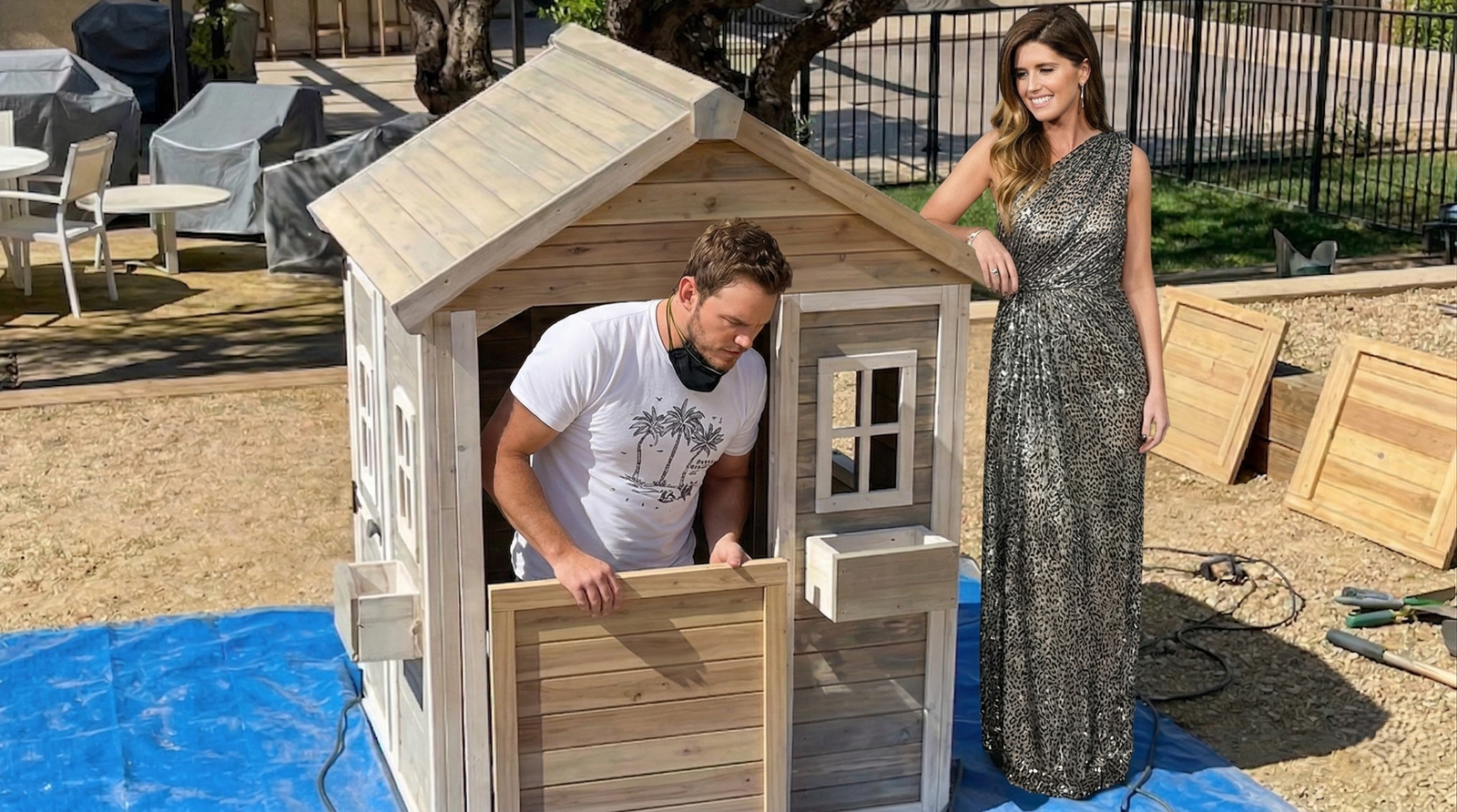
Hollywood’s power couples chase headlines, drop cryptic posts, and perform their relationships for millions. The Pratts build dollhouses. And Katherine Schwarzenegger has a few things to say about why that difference is not an accident.
A Dollhouse That Said More Than a Thousand Red Carpet Moments

It started with sawdust and a Saturday afternoon. Chris Pratt, one of Hollywood’s highest-paid action stars, spent a weekend hunched over lumber and blueprints building a handmade dollhouse for his daughters. Not buying one. Not delegating it. Not posting about it in real time. Katherine mentioned it quietly in an interview, the kind of detail she brought up not for applause but because it genuinely moved her. In a celebrity landscape defined by performance, the gesture landed differently precisely because nobody performed it.
Katherine Has Never Pretended to Be a Different Kind of Wife

From the moment their relationship went public, Katherine made clear she was not reshaping herself into a more palatable version of modern partnership for the sake of optics. She speaks openly about faith, about presence, about choosing family over the career ambitions Hollywood treats as the only legitimate measure of a woman’s worth. In an industry that rewards women for performing independence, Katherine chose something quieter and has defended it with a composure that reads less like rigidity and more like certainty.
Traditional Values in a Town That Treats Them as a Punchline

In most rooms on the west side of Los Angeles, the word “traditional” functions as a polite euphemism for something outdated, something to be grown out of or quietly apologized for. Katherine Schwarzenegger has declined that social contract entirely. She speaks about her Catholic faith as a genuine operating system for her life, not a performance of virtue. People who know the Pratts consistently describe a household where stated values and lived reality actually occupy the same space.
Chris Pratt Has Been Quiet, and That Itself Is the Statement

Pratt has absorbed significant cultural criticism in recent years for his church affiliation, for comments made and interpreted in the public sphere, for the inconvenient fact of being a visibly Christian man in Hollywood. His response has been to say very little and do a great deal. He coaches his son’s sports teams. He shows up. He builds dollhouses on weekends. The loudest argument he has made in his own defense is the texture of his daily life, which his wife describes with a consistency and specificity that is very difficult to fake.
What Katherine Actually Said and Why It Resonated

Katherine was not delivering a manifesto. She was answering a question and she answered it honestly which in the current media climate is its own kind of radical act. She talked about wanting her children raised by a present father, a home where faith is practiced rather than merely mentioned, and a partnership built on something more durable than mutual convenience. The internet split predictably down the middle. Katherine, characteristically, appeared unbothered by both sides.
The Schwarzenegger Factor and Why She Is Her Own Person

Her father is Arnold Schwarzenegger. Her mother is Maria Shriver. Katherine grew up watching two extraordinarily public figures manage the gap between their public image and their private reality, a gap that, in her parents’ case, became a defining story of her childhood. What she appears to have taken from that front-row education is a fierce determination to close it. To have her stated values and her actual life running in the same direction, not in embarrassed parallel.
In Defending Her Marriage, She Is Defending a Choice, Not a Prescription

The most important nuance in everything Katherine says about marriage is what she is not saying. She is not arguing that every woman should make her own choices. She is not suggesting traditional family structures are the only valid ones. She is saying, with quiet consistency, that her choice deserves the same respect any other choice receives, that a woman who prioritizes faith, home, and partnership has not failed to think for herself but has thought carefully and arrived somewhere real. In a culture that celebrates women’s choices in the abstract while quietly dismissing certain choices in particular, that is a harder argument to make than it sounds.
About the Author