The sun-kissed look is usually associated with carefree days and a certain level of confidence, yet the process of achieving this look does not necessarily have to be carried out by the sun. Self-tanning has been a comfortable choice for a large number of individuals who like having a warm color but do not wish to change their daily routine too much. It may be daunting initially, as there are a great deal of textures, shades, and tips flying about. Nevertheless, the procedure is not always complex and might even be pleasant after getting used to it. This guide is to reduce any reluctance to answer frequently asked questions and to make tanning oneself more of a small, pleasant ritual—to make tanning oneself less of a duty and more of a ritual that can fit perfectly into regular life.
Choosing a shade that feels like you

To get the right shade, one may rely on personal comfort and not necessarily on rules. Some take the low-key warmth, and there are those who favor the richer sound. An experiment on a small part can be useful in determining what is comfortable and flattering in the long run.
Preparing skin without overthinking it

It can be an easy and informal preparation. Smooth skin that is clean tends to evenly put on the color. This step is not required to be complex and should only be considerate enough to form an amiable foundation upon which it is to be applied.
The importance of texture and formula

Lotions, mousses, and serums all may have a different feel on the skin. Some absorb quickly and others take more working time. The most desirable one is the one that can easily be incorporated into a routine without being felt as heavy or hurried.
Applying with patience, not pressure
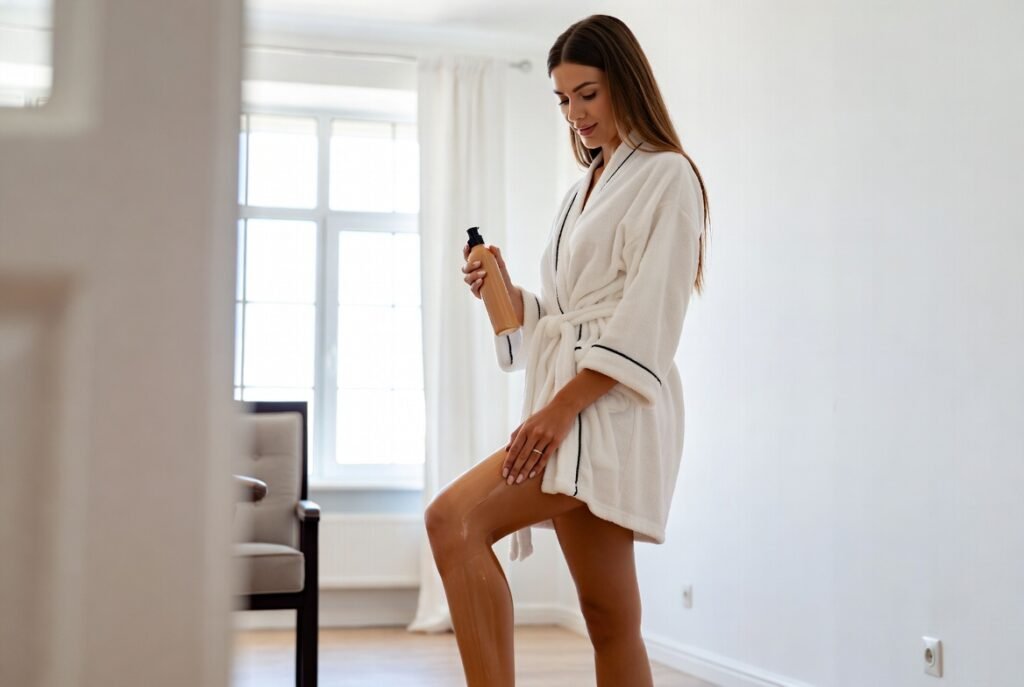
Self-tanning is more likely to be better when done in a cool manner. Even movement can be used to blend the product naturally, though slowly. One does not need to be perfect, as minor changes are not always noticeable when the color evolves.
Letting the color develop comfortably

The time of development may also be different based on skin and product. Leaving the color to dry also has the tendency to produce a softer finish. It is the period when comfort and patience tend to be more important than observing the clock.
Managing expectations with real life in mind

Self-tanner does not necessarily appear the same on all people and on all occasions. Factors can include temperature, skin condition, and daily habits. It is a good idea to embrace some form of uncertainty, which usually makes the experience delightful.
How long results might last

The radiance usually goes away as skin naturally replenishes itself. Others observe a color duration of several days, whereas others have a shorter perception. The transient aspect can be useful in changing shade preferences in the long run.
Refreshing without starting over

Sometimes, touch-ups can prolong the appearance without having to apply it completely. A little addition of product to some regions can be done. This is a method that is usually less exerting as compared to going through the whole process over again.
Fitting self-tanning into busy schedules

Tanning does not necessarily have to occupy an evening. It can be learned and could be a fast action that can be incorporated into everyday schedules. It becomes easier for many people when it is not new but familiar.
Enjoying the glow without stress

At its finest, self-tanning (at least) should be light and pleasant. It can bring an unobtrusive enhancement when handled flexibly and with interest. It is not about perfection but comfort, and the attitude is oftentimes reflected.
About the Author